Starting Genealogy Research: What to Do Before Hiring a Professional Genealogist
Preparing to start genealogy research? Learn what information to gather, how to organize family records, and how professional genealogy research can help.
GETTING STARTED WITH GENEALOGY
1/25/20263 min read
Begin by gathering the information you already know about your family. Even partial details can be helpful when starting genealogy research. Names, approximate dates, locations, and family relationships often provide the first clues needed to begin identifying historical records.
Information about parents, grandparents, and earlier generations can be especially useful. Birthplaces, marriage locations, occupations, and known migrations between communities may all help guide the research process.
Family stories, traditions, and memories can also provide valuable starting points. Although some details may later require verification through historical records, these accounts often contain important clues about people, places, and relationships.
These details provide the foundation that professional genealogy research builds upon.
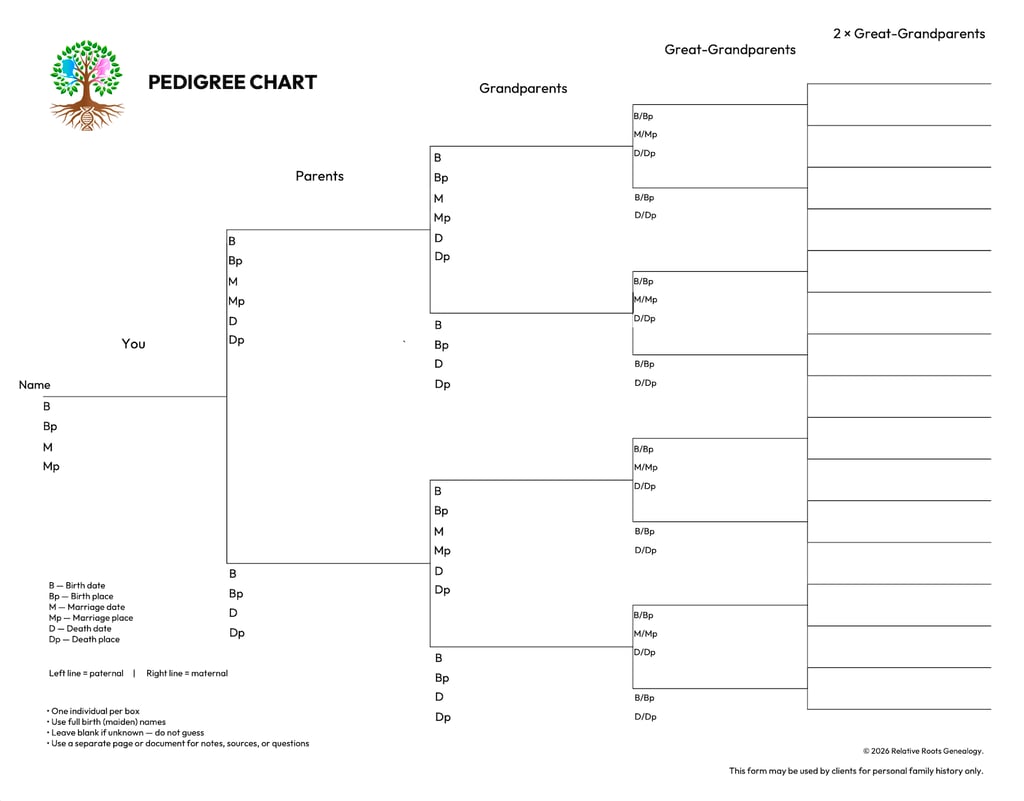
Completing a simple pedigree chart like the example below can help organize the information you already have and quickly highlight where additional research may be needed.
Start with what you already know
Starting genealogy research can feel overwhelming, especially if you are unsure what information you already have or what records may be useful. Preparing before beginning professional genealogy research helps clarify goals and allows historical records to be used more effectively during the research process.
Conversations with family members are often one of the most valuable starting points for genealogy research. Parents, grandparents, aunts, uncles, and older relatives may recall names, locations, relationships, or stories that are not recorded elsewhere.
When speaking with family members, it can be helpful to ask about details such as full names, nicknames, places lived, occupations, religious affiliations, and any known migrations. Even informal recollections can provide important clues that guide documentary research later. Recording conversations or taking notes during these discussions can help preserve details that may otherwise be forgotten.
Talk to family members while you can
Gather documents and photographs
Any documents or photographs you already have can be helpful, even if they seem incomplete or informal. Birth, marriage, and death records, immigration papers, family Bibles, and old correspondence can all provide valuable information.
Photographs may include handwritten notes, studio names, locations, or dates that add context. Digital scans or phone photos are sufficient at this stage—original condition is not critical.
If documents are missing or incomplete, that is common and does not prevent meaningful research from moving forward. Even partial records can provide important clues.
Write down your questions or goals
Taking time to identify what you hope to learn can make professional research more focused and efficient. Your goals might include identifying an unknown ancestor, confirming family connections, understanding DNA results, or resolving conflicting information.
Clear research goals also help identify when professional genealogy research may be useful for addressing more complex family history questions.
What not to worry about
Many people hesitate to begin genealogy research because they feel their information is incomplete or unreliable. It is not necessary to have every detail confirmed before starting. Incorrect family trees, missing records, or confusing DNA results are common and can often be addressed through careful research.
The purpose of an initial consultation is to assess what information is available, clarify uncertainties, and determine realistic next steps—not to judge the quality of existing research.
Professional research is designed to address uncertainty, not require complete or flawless information at the outset. Preparing in advance can make genealogy research more productive, but it is only the starting point.
Professional research builds on the information you provide and applies careful analysis, documentation, and evidence-based methods to answer your questions.
Preparing in advance can make genealogy research more productive, but it is only the starting point. Professional research builds on the information you provide and applies careful analysis, documentation, and evidence-based methods to answer your questions.
When professional genealogy research may help
If you are unsure how to proceed or would like guidance on your next steps, a free consultation can help clarify whether professional genealogy research is appropriate for your situation.
Free consultation • No obligation
Your information is kept confidential
© 2026. All rights reserved.
Located in Victoria, British Columbia, Canada