A small practice, carefully run.
Relative Roots Genealogy offers professional genealogical research from Vancouver Island, British Columbia, conducted personally, one project at a time.
Evidence-based family history.
Relative Roots Genealogy provides professional, evidence-based family history research. Research follows the Genealogical Proof Standard: every conclusion is supported by documented historical evidence, every source is cited, and every reasoning step that links the evidence to the conclusion is written out, so it can be checked, questioned, and built upon long after the project is closed.
The work is conducted personally. There is no research team. Each project is taken on by the same person who consults with you, drafts your research plan, reads the records, and writes the report.
An investigator, not a data collector.
Family history research has been part of my life for 25 years, long before it became a profession. What drew me in then, and what still drives the work now, is something closer to investigation than data entry: the search for documents, the evaluation of evidence, and the gradual understanding of a real person’s life. Where did they live? What did they do? What would it have felt like to be them?
Early on, I made the mistakes most family historians make. I assumed. I filled gaps with probability rather than proof. I connected people to families because it seemed likely, not because I could demonstrate it. Over time, and through the discipline of working to recognised genealogical standards, I came to understand why those shortcuts fail. Now, nothing goes into a tree without documented evidence to support it. It is a slower way to work. It is also the only way to produce research a client can trust and build on.
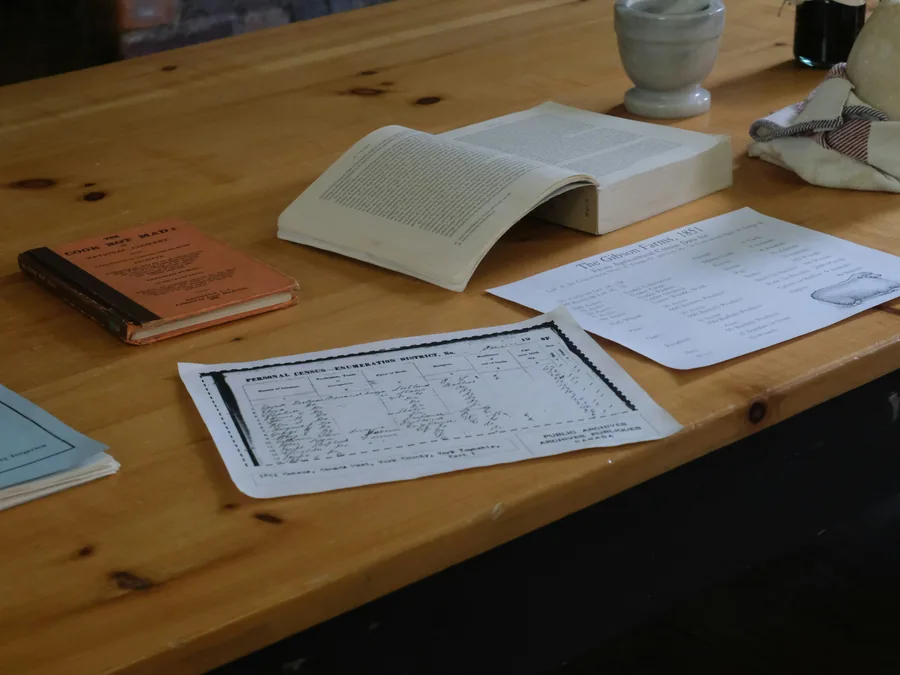
When I put a person or a fact into a tree, I know it is true.
That confidence is not a marketing claim. It is the practical result of working carefully from primary sources and documenting every step. Clients receive research they can stand behind, explain to others, and continue building on. Where the evidence is thin, that is stated openly. Where a conclusion cannot yet be proved, that is noted too.
The standards in question, the Genealogical Proof Standard, and the conventions of the Board for Certification of Genealogists, are the discipline’s settled view of what good practice looks like. The practice holds itself to them; it does not lead with credentials.
This work is personal.
My own family history drew me into genealogy. Over 25 years of personal research, I have followed my own lines across Canada, the United States, England, Scotland, France, and eastern Europe. Each region has its own archival system, its own record survival problems, and its own research conventions. Working through those challenges on my own family, not as exercises, but as genuine research questions I wanted answered, built the practical knowledge I now bring to client work.
One line of that research took me into Métis community history and the North-West Resistance records. I am a Métis citizen myself, and I have been through the provincial registry application process personally. That direct experience is part of what I draw on when working with Métis ancestry and citizenship clients, but it is one strand of a broader practice that has always been grounded in the work itself.
The judgement is the researcher’s.
Modern tools assist with the administrative parts of the work: transcription support, file management, source cataloguing. All genealogical analysis, every source evaluation, and every conclusion is made by the researcher personally. No automated system substitutes for professional judgement here. The records, the evidence, and the reasoning behind every finding are reviewed and written by hand.
If you have received a tree from an automated service or an online platform that gathered names without citations, we are happy to read it critically and tell you what the records actually support.
Every project begins the same way.
- A free 30-minute consultation, to understand your goals, what you already have, and whether the work is a good fit. No commitment required.
- Then one of two paths. Work with a documentation goal, such as a citizenship or registry application, is quoted as a single fixed price before anything begins, so the total does not move if the research runs long. Everything else starts with a ten-hour foundation retainer: organising your information, building your tree in a professional genealogy application, and beginning research toward your stated goals.
- A written report: what was found, what it means for your research questions, and a clear path forward. On a fixed-price package that is the complete cited file; on a retainer it is a preliminary report at the ten-hour mark.
- Continued research, additional hours scoped based on the preliminary findings and your goals. The direction is guided by evidence, not assumptions.
If your family has a question
the records may have an answer.
Start with a free 30-minute conversation, no commitment required.
Book a Free Consultation →