Métis Ancestry & Citizenship Documentation
Tracing Métis family lines through historical records: parish registers, census returns, scrip applications, Hudson’s Bay Company archives. The research may support a citizenship application or simply serve a family’s own history.
Individuals applying for Métis Nation citizenship who need their ancestry documented to the standard a citizenship registry expects. Also: people who suspect Métis ancestry from family stories and want to understand what the records actually say. This research can serve a citizenship application or stand on its own as family history.
I am a Métis citizen myself. My own family research took me through the same archives, the same application process, and the same moments of uncertainty that bring most people to this work. I know which lineages the provincial registries look for, where the records are held, and where the gaps are. When I take on Métis ancestry research, I am not approaching it from the outside.
What the research typically involves.
- We begin with what is known: names, places, family stories, any prior research. Métis lines move between communities frequently, and oral history matters here.
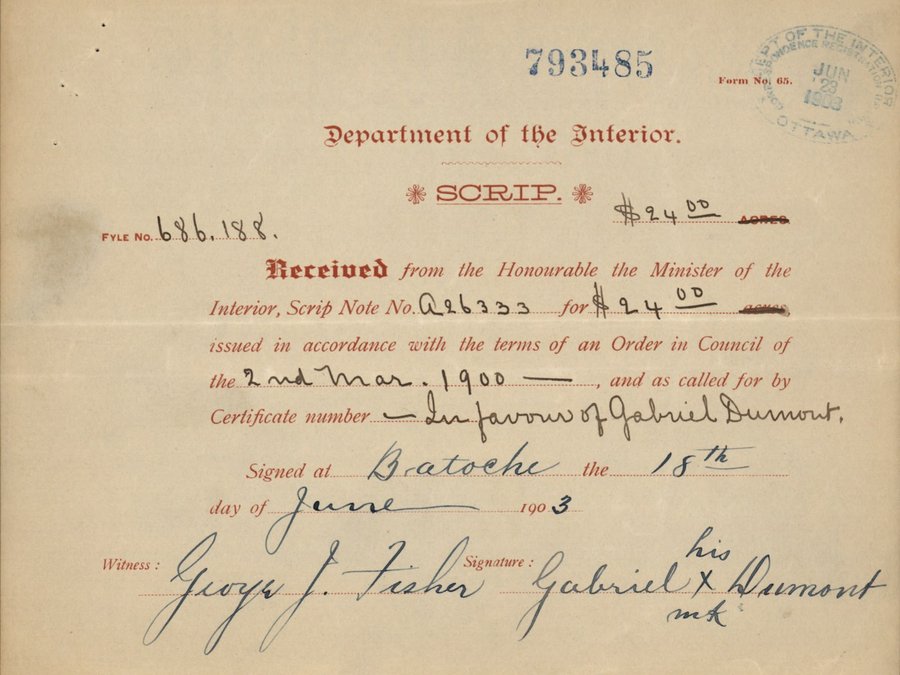
- Research draws on the specific records that document Métis families: parish registers in Red River, St. Boniface, Pembina and the Saskatchewan parishes; scrip records; HBC employee and family records; and census returns.
- Connections are traced generation by generation, with attention to the documentation standards a citizenship registry will apply. Where a record is ambiguous, this is said plainly.
- Findings are presented so they support both a citizenship application and a personal understanding of the family’s history.
Documented findings, yours to keep.
A documented lineage from the citizenship applicant back to the qualifying ancestor, with cited sources and copies of every record consulted.
Transparent Pricing
Pricing depends on what the work is for.
Research for a citizenship application is quoted as a fixed price, agreed after the free consultation. A registry either accepts your documentation or sends it back, and that raises the standard the work has to meet. You are told the total before anything begins, and it does not change if the research turns out to take longer than expected. That risk is mine, not yours.
Research for your own family history is $95 CAD per hour, beginning with a ten-hour foundation retainer of $950 CAD. At the ten-hour mark you receive a preliminary report: what has been found, what it means, and what the logical next steps are. From there you decide how to proceed: continue, pause, or close the file. The retainer is earned as the work is performed. Any hours you purchase beyond it can be refunded on request if they go unused. Where a research goal genuinely needs less than ten hours, I quote a smaller block instead.
You stay in control of the project from start to finish. The free consultation is where we work out which of the two the work actually is.
Every family starts from a different place. Some clients arrive with names going back four generations; others are starting from a single family story. The scope and the timeline depend entirely on what is already known. The free consultation is where I can give you an honest estimate, once I have heard what you have.
Understanding Métis ancestry research
Métis genealogy is a distinct discipline. The records that matter, fur trade ledgers, mission registers, scrip applications, Red River censuses, Hudson’s Bay Company personnel files, are not where most researchers expect to find them, and they require familiarity with the historical geography of the Northwest to interpret correctly. A name that appears one way in an English-language census may appear differently in a French parish register or a scrip affidavit, and the same individual may appear across multiple record sets under variant spellings.
Citizenship applications require a documented genealogical connection to an ancestor who was recognised as Métis and who lived in the historic Métis homeland. Every registry asks for cited, primary-source documentation, and every one of them requires the chain from you to that ancestor to be proven generation by generation. Research for a citizenship application is not the same as general family history research: the goal is a specific, verifiable connection, documented to the standard of the government you are applying to.
What that standard is differs more than most people expect. Saskatchewan asks for an ancestor who appears in scrip records or was recorded as Métis in a census. Alberta accepts a land grant or scrip, or recognition in government, church or community records. Ontario requires an ancestor in the homeland after 1750, and states plainly that the word Métis need not appear on the document, since Half breed, French breed, English breed, Scotch breed, chicot and bois-brulé all appear in the historical record. Manitoba requires a connection to the historic Red River Métis and asks for a genealogy prepared by the St. Boniface Historical Society. Knowing which standard applies before the research starts is the difference between a file that is accepted and one that is sent back.
If you are researching Métis ancestry for personal family history rather than a citizenship application, the same records apply. The scope and the deliverable are simply different.
Métis Nation governing bodies
Each of these governments operates its own citizenship registry under its own constitution and legislation. They are not branches of a single national body, and the Métis National Council does not register anyone. Requirements, evidence standards and processing times differ between them.
Ask the registry what it already holds before commissioning any research. Several of them do a great deal of the work themselves, at no cost. Métis Nation British Columbia asks for birth certificates only for ancestors born after 1901 and researches the rest through its own Indigenous Research team. Métis Nation–Saskatchewan holds more than 500,000 digitised records and can request Saskatchewan and Alberta vital records directly. Métis Nation of Ontario may already have assessed your family line. It is worth a phone call before you spend anything.
A note on research outcomes
Research does not always produce the connection a client is hoping for. Records were not always kept, and not everything that was recorded has survived. If a search comes up empty, you receive documentation of exactly where I looked: every archive consulted, every negative result recorded, so the work is transparent regardless of the outcome. I also draw on local researchers and historical societies when specialized knowledge of a specific community or region would help.
Questions about Métis research.
Do you have direct experience with Métis research, or is this a general genealogy service?
I am a Métis citizen myself. My own family research took me through the same archives, the same application process, and the same moments of uncertainty that bring most people to this work. I know which lineages the provincial registries look for, where the records are held, and where the gaps are. I am not approaching this from the outside.
What records actually document a Métis family line?
The records that matter are not where most researchers expect them: parish registers in Red River, St. Boniface, Pembina and the Saskatchewan parishes; scrip applications; Hudson’s Bay Company employee and family records; and census returns. A name may appear one way in an English-language census and differently in a French parish register or a scrip affidavit, so reading these records correctly takes familiarity with the historical geography of the Northwest.
Is research for a citizenship application different from family history research?
Yes. Research for a citizenship application aims at a specific, verifiable connection documented to the governing body’s standard, while personal family history uses the same records toward a different deliverable. Citizenship applications for Métis Nation governing bodies require a documented genealogical connection to a recognised Métis ancestor, with cited primary-source documentation. The standard of proof varies between governing bodies.
Which Métis Nation do I apply to?
For most people it is the government of the province where they live, but the rules are not the same across the five, so it is worth checking before you apply.
Three do not require you to live in the province. Alberta states that eligibility for citizenship is independent of a person’s place of residence. The Manitoba Métis Federation removed any residency requirement deliberately, describes itself as a government beyond borders, and provides for applicants living outside Canada. Ontario repealed its residency clause in 2019.
Two do require it. Métis Nation British Columbia requires an applicant to normally reside within its jurisdiction. Métis Nation–Saskatchewan requires six months of residence in the area of a Métis Local, and its Constitution allows Locals to make exceptions for education or medical reasons.
You can generally hold citizenship with only one Métis government. Alberta, British Columbia and Manitoba each require applicants to declare they are not registered elsewhere. Ontario is the exception and permits concurrent registration with the other four. Because the governments themselves do not agree on this, ask directly rather than assume, and do not apply to a second while holding a first.
Their ancestry requirements differ too. The clearest example is that the Manitoba Métis Federation requires a demonstrable connection to the historic Red River Métis, while the other governments define the homeland more broadly as west central North America. A family that qualifies in one province may not qualify in another.
The research traces your line to the qualifying ancestor and documents it to the standard of the government you are applying to.
How much does it cost, and how long does it take?
For a citizenship application, the work is quoted as a fixed price after the free consultation. You know the total before anything starts, and it does not change if the research runs longer than expected. For personal family history, research is $95 CAD per hour, beginning with a ten-hour foundation retainer of $950 CAD and a preliminary report at the ten-hour mark. The retainer is earned as the work is performed. Additional hours purchased later can be refunded on request if they go unused. Where a goal genuinely needs less than ten hours, I quote a smaller block instead. Archives and registries set their own response times, so a completion date is not something I can honestly promise you. And before you spend anything at all, please read the note above about asking your registry what it already holds. Several of them do a great deal of this work themselves, at no cost.