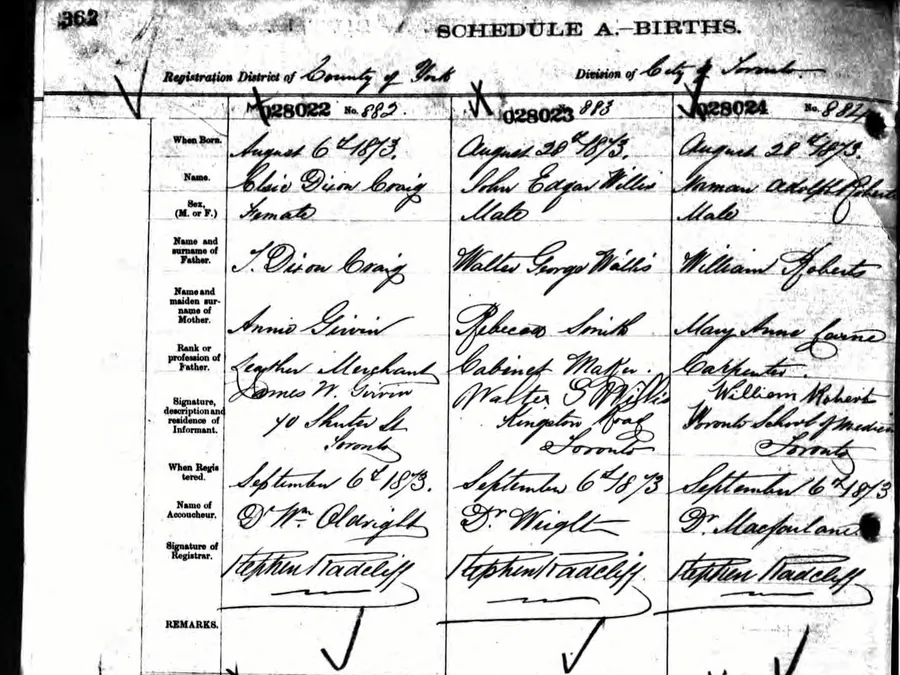
# Genealogist First or Lawyer First? What Each One Does With a Citizenship by Descent File
You have worked out that a Canadian grandparent or great-grandparent may matter to you, and now the question is who to ask for help. The immigration law sites say hire a lawyer. A genealogist says the records are the hard part. People often come to a consultation believing they have to pick one, and that picking the wrong one wastes money.
In short: the two do different jobs on the same file, and Immigration, Refugees and Citizenship Canada draws the line between them. IRCC’s page on representatives says that only an authorized representative, meaning a lawyer or paralegal in a Canadian law society, a Quebec notary, or a consultant licensed by the College of Immigration and Citizenship Consultants, can be paid to give advice on your citizenship options, fill out and submit the application, or communicate with the Government of Canada on your behalf. A genealogist does none of those things. What a genealogist does is find the record for each generation, confirm what it proves, and document where the authentic copy comes from. That is the part of the file IRCC’s checklist spends most of its pages on, and two of the three reasons for refusal that CIC News describes are problems with it.
What to know before you start
– IRCC says you do not need to hire anyone. The forms and instructions are free, and using a representative does not draw special attention to an application.
– Only an authorized representative can be paid for advice on your options, for completing the application, or for dealing with IRCC for you. A genealogist is not one.
– The checklist, CIT 0014 (08-2026), asks for authentic, reliable and verifiable documents for every generation, issued by the original authority. Finding and documenting those is research work.
– Where a record does not exist, IRCC asks for a written explanation and proof that you tried. Producing that proof is research work too.
– The lawyer’s work and the genealogist’s work do not overlap, so hiring one is not a reason to skip the other.
What does IRCC say about who can help with a citizenship application?
IRCC’s page Learn about representatives, last modified 18 August 2026, starts with a plain statement: you do not need to hire a representative, the forms and instructions are free on its website, and using one will not draw special attention to the application or mean it will be approved (Learn about representatives).
The same page defines what a representative does. Representatives explain and give advice on your immigration or citizenship options, fill out and submit the application, communicate with the Government of Canada on your behalf, and represent you in an application or hearing. It then divides them into two kinds. A paid representative must be authorized: lawyers and paralegals who are members in good standing of a Canadian provincial or territorial law society, notaries who are members of the Chambre des notaires du Québec, and citizenship or immigration consultants who are members of the College of Immigration and Citizenship Consultants. IRCC says it will not deal with representatives who charge a fee but are not authorized, and that using one may lead to the application being returned or refused. An unpaid representative, a friend or family member, may do the same things for free.
That rule settles the first half of the question. A professional genealogist is paid and, unless they also happen to hold one of those three licences, is not an authorized representative. So a genealogist cannot, for a fee, tell you whether you qualify, fill out form CIT 0001 for you, or write to IRCC about your file. If anyone describing themselves as a genealogist offers to do those things for money, IRCC’s page is the reason to decline.
IRCC’s page also lists help that does not make someone a representative at all: using the website to find information, getting documents translated, or using electronic forms. Research into which records exist and where they are held is not on IRCC’s list either way, because it is not a step in the application. It is what the application is built from.
What does the lawyer actually do on a citizenship by descent file?
The clearest public account is from CIC News, an immigration news site whose citizenship articles carry a consultation link to Cohen Immigration Law. Its article of 29 August 2026 lists what a lawyer handles: an eligibility analysis, identifying which application stream applies, mapping the chain of descent and pinpointing which generation eligibility comes from, choosing the strongest route where there is more than one Canadian ancestor, specifying which documents the file needs, reviewing the documentation for holes, drafting a letter of explanation for discrepancies and a cover letter for the officer, and acting as representative of record after filing, so that IRCC’s correspondence and any procedural fairness letter come to the lawyer (CIC News, 29 August 2026).
The same article is equally clear about what a lawyer cannot do. It says collecting the bulk of your ancestors’ documentation is usually your job unless you have paid for a specific service that says otherwise, that no representative can move a file ahead in the queue, and that no lawyer or consultant can guarantee an outcome, because the decision sits with the officer reviewing the file.
Read those two lists together and the division of labour is already visible. Advice, forms, strategy, letters and representation are the lawyer’s. The documents themselves, for every generation, are described by the lawyer’s own site as the applicant’s problem.
Which problems on the lawyer’s list are actually records problems?
CIC News followed up on 23 September 2026 with ten situations in which it says an applicant is well served by a lawyer (CIC News, 23 September 2026). The lawyer quoted in it, Daniel Ciarabellini, says that the more generations a chain of descent goes back, the more its complexity rises, and the article adds that every generation brings another birth certificate, a name that may have changed, and another archive that may not have kept what you need.
Several of the ten are, on their own description, questions about records rather than law. For a line that runs through Indigenous ancestry, the article says the hard part is identifying which authority actually holds the record and what that office can issue today. For an anchor ancestor born or naturalized before 1947, it says there is no citizenship certificate to find, and status is proved through birth registrations, census entries, boat manifests, landing records and naturalization files. For Acadian and Cajun lines, it says generations may be documented only in parish registers, colonial lists or archives in a third country, in French or in old script. For names and dates that do not match, it says the question is which discrepancies need explaining and which need a different document entirely. For Quebec, it is which office holds a record and what it can issue. And the ninth situation, not knowing where to start, is described as collecting records from every person in the line, sometimes across countries and languages, each from the authority that created or keeps it.
Every one of those is a question a genealogist answers for a living. Which office registered births in that county in that decade. Whether a baptism was recorded within a reasonable time of the birth. Where the court copy of a Quebec parish register sits today. Whether the man in the 1901 census is the same man as the one in the Michigan death certificate, and what proves it. None of it is legal advice. All of it has to be settled before a lawyer has anything to review.
What does IRCC’s checklist ask for, generation by generation?
The checklist is the document that makes the records side concrete. CIT 0014 (08-2026) opens with two sentences: your application must be supported by authentic, reliable and verifiable documents for every generation in your application, and your application cannot be supported solely by third-party records (CIT 0014 (08-2026), page 1). It also warns that failure to provide the necessary documents will result in the return of the application, and that where several family members apply together and one application is incomplete, all of them are returned.
For a person born outside Canada to a Canadian parent, the checklist’s Scenario 3 asks for proof of parentage and Canadian citizenship for your Canadian parent, grandparent and parental ancestor, and says that for each person you must provide one or more documents issued by the original authority: a provincial or territorial birth certificate, a birth certificate from another country that shows the parent-child relationship in each generation, a Canadian citizenship or naturalization certificate, a Certificate of Registration of Birth Abroad or of Retention of Canadian Citizenship, a British naturalization certificate issued in Canada or Newfoundland and Labrador, or other evidence of the parent’s citizenship of the kinds described in its Scenarios 4 and 5 (page 3). The checklist adds that IRCC may ask for further information or documents when processing the application.
The instruction guide, CIT 0001, says what happens when a birth certificate does not exist. If you do not have a birth certificate or birth record for yourself or any parental ancestor, you must send other documents to show parentage and Canadian citizenship, issued by the original authority, which can include a hospital record of birth, a record from the physician or midwife who witnessed the birth, a baptismal certificate or record where the baptism took place within a reasonable time after the birth, census records, or a boat manifest. And if you cannot provide official documents issued by the original authority at all, you must explain in writing why, and show proof that you tried to get them, for example emails or letters with the original authorities or confirmation that the records are not available (Guide CIT 0001, paper applications, page modified 23 September 2026, sections What we accept and If you can’t provide official documents issued by the original authority).
That last requirement is the one people underestimate. A documented negative search, with the archive’s own letter saying the register for those years does not survive, is a record in its own right, and it is exactly the confirmation IRCC’s guide asks for. Our post on what IRCC now accepts as proof goes through the June and August changes to this checklist in detail.
What happens when the records are wrong?
CIC News’s article of 1 October 2026 on refused applications, again written with a Cohen Immigration Law lawyer, lists the usual reasons: the documents may leave gaps in the lineage, the form may contain errors, or the chain may break at one of the generations (CIC News, 1 October 2026). It says IRCC usually gives applicants a chance to respond first, through a procedural fairness letter or a request for documents, and that where an officer found a missing generational link, the applicant needs a record for that generation before applying again. The same article notes that an application returned as incomplete has not been refused: what is missing is added and it is sent back.
Two of those three reasons are records problems. A gap in the lineage is a generation with no document naming the parents. A broken chain is a question of what a naturalization file or a renunciation record actually says, which is a question of finding and reading the record before anyone argues about its effect. Only the form error is purely an application problem. The procedural steps that follow a refusal, a reconsideration request or an application to the Federal Court, are legal work, and CIC News’s article is the place to read about them; they are not something a genealogist does.
So which one first?
Start with the question you actually have. If the question is whether a particular set of facts qualifies, that is advice on your citizenship options, and IRCC’s rule means the only people who can be paid to answer it are authorized representatives. If the question is which records exist for your family, where they are held, and whether they prove what you need them to prove generation by generation, that is research, and it is the same work whether or not a lawyer is ever involved.
In practice the two are not competing for the same money. A lawyer reviewing a file needs the documents in front of them; the 29 August article says plainly that gathering them is the applicant’s job. A genealogist building the documentary chain stops at the boundary IRCC draws: the research establishes and documents the genealogical chain, and the legal interpretation of that chain, including whether it meets IRCC’s requirements in your case, sits with you or your immigration counsel. That is how our citizenship by descent research service is described, and it does not require you to retain a lawyer or a consultant before the research starts, or forbid you from doing so. One workable order is to do both: the records first, because they decide what there is to argue about, and the lawyer once the file exists.
Whichever you choose, the checklist’s first sentence does not change. Every generation needs an authentic, reliable and verifiable document issued by the original authority, and a printout from a subscription site is not one. Our post on American records in a Canadian file shows what that looks like for the generations on the United States side of the line.
Frequently asked questions
Do I need a lawyer to apply for a Canadian citizenship certificate?
IRCC says no. Its page on representatives states that you do not need to hire one, that the forms and instructions are free on its website, and that using a representative does not draw special attention to your application or mean it will be approved. Whether a lawyer is worth it in your case is a decision only you can make, and CIC News’s 23 September 2026 article sets out ten situations in which it says applicants are often well served by one.
Can a genealogist fill out my citizenship application or tell me if I qualify?
Not for a fee. IRCC’s rules allow only authorized representatives to be paid to give advice on your citizenship options, complete and submit the application, or communicate with the Government of Canada on your behalf: lawyers and paralegals in a Canadian law society, Quebec notaries, and consultants licensed by the College of Immigration and Citizenship Consultants. A professional genealogist is not one of those, so the work stops at finding, evaluating and documenting the records.
What does a genealogist do on a citizenship by descent file?
The genealogist identifies the record that proves each generation, confirms what it says and whether it proves the link, and documents which original authority holds the authentic copy and what that office requires. Where a record does not exist, the genealogist produces the documented search IRCC asks for when it says to explain in writing and show proof that you tried.
What does IRCC require for each generation?
Checklist CIT 0014 (08-2026) requires authentic, reliable and verifiable documents for every generation, issued by the original authority, and says the application cannot be supported solely by third-party records. For a Canadian parent, grandparent or earlier ancestor it lists a provincial or territorial birth certificate, a foreign birth certificate showing the parent-child relationship, a citizenship or naturalization certificate, a Registration of Birth Abroad or Retention certificate, or a British naturalization certificate issued in Canada or Newfoundland and Labrador.
What if a birth certificate was never issued for my ancestor?
IRCC’s guide says to send other documents issued by the original authority that show parentage and Canadian citizenship, and names a hospital record of birth, a physician’s or midwife’s record, a baptismal certificate where the baptism took place within a reasonable time after the birth, census records, and a boat manifest. If none can be obtained, you must explain in writing why and include proof that you tried, such as letters from the original authorities confirming the records are not available.
Should I hire the genealogist or the lawyer first?
It depends on which question you have. If you need advice on whether your facts qualify, only an authorized representative can be paid to give it. If you need to know which records exist and what they prove, that is research, and the records have to exist before anyone can advise on them. One workable order is the research first, with the finished file then brought to a lawyer.
If the line in your family has a generation nobody can document yet, the useful first step is working out which record exists for it and where it is held. Book a free consultation and we can look at what the chain rests on before you decide who else you need.
Sources
– Immigration, Refugees and Citizenship Canada, Learn about representatives, page modified 18 August 2026, read 4 October 2026.
– Immigration, Refugees and Citizenship Canada, Document Checklist: Application for a Citizenship Certificate (Proof of Citizenship), CIT 0014 (08-2026) E, read 4 October 2026.
– Immigration, Refugees and Citizenship Canada, Guide for Paper Applications for a Citizenship Certificate for Adults and Minors (Proof of Citizenship) under Section 3 (CIT 0001), page modified 23 September 2026, read 4 October 2026.
– CIC News, Canadian citizenship by descent: What an immigration lawyer can do for your application, and what they can’t, 29 August 2026, read 4 October 2026.
– CIC News, Canadian citizenship by descent: When should you hire an immigration lawyer?, 23 September 2026, read 4 October 2026.
– CIC News, My Canadian citizenship by descent application was refused. What are my next steps?, 1 October 2026, read 4 October 2026.