Métis Ancestry & Citizenship Documentation
Tracing Métis family lines through historical records: parish registers, census returns, scrip applications, Hudson’s Bay Company archives. The research may support a citizenship application or simply serve a family’s own history.
Individuals applying for Métis Nation citizenship who need their ancestry documented to the standard a citizenship registry expects. Also: people who suspect Métis ancestry from family stories and want to understand what the records actually say. This research can serve a citizenship application or stand on its own as family history.
I am a Métis citizen myself. My own family research took me through the same archives, the same application process, and the same moments of uncertainty that bring most people to this work. I work from each registry’s own published requirements, and I know where the records are held and where the gaps are. When I take on Métis ancestry research, I am not approaching it from the outside.
What the research typically involves.
- We begin with what is known: names, places, family stories, any prior research. Métis lines move between communities frequently, and oral history matters here.
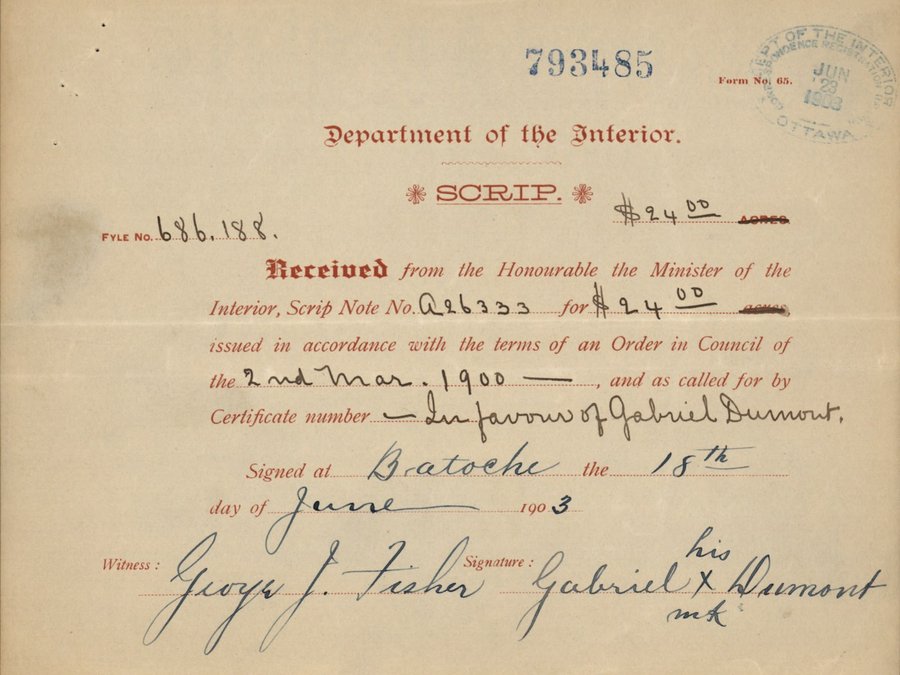
- Research draws on the specific records that document Métis families: parish registers in Red River, St. Boniface, Pembina and the Saskatchewan parishes; scrip records; HBC employee and family records; and census returns.
- Connections are traced generation by generation, with attention to the documentation standards a citizenship registry will apply. Where a record is ambiguous, this is said plainly.
- Findings are presented so they support both a citizenship application and a personal understanding of the family’s history.
Documented findings, yours to keep.
A documented lineage from the citizenship applicant back to the qualifying ancestor, with cited sources and copies of every record consulted.
Transparent Pricing
One rate, whatever the work is for.
Research for a registry application or for your own family history is $75 CAD per hour, beginning with a ten-hour foundation retainer of $750 CAD. At the ten-hour mark you receive a preliminary report: what has been found, what it means, and what the logical next steps are. From there you decide how to proceed: continue, pause, or close the file. The retainer is earned as the work is performed. Any hours you purchase beyond it can be refunded on request if they go unused. Where a research goal genuinely needs less than ten hours, I quote a smaller block instead.
You stay in control of the project from start to finish. The free consultation is where we work out what the research needs.
Every family starts from a different place. Some clients arrive with names going back four generations; others are starting from a single family story. The scope and the timeline depend entirely on what is already known. The free consultation is where I can give you an honest estimate, once I have heard what you have.
Understanding Métis ancestry research
Métis genealogy is a distinct discipline. The records that matter, fur trade ledgers, mission registers, scrip applications, Red River censuses, Hudson’s Bay Company personnel files, are not where most researchers expect to find them, and they require familiarity with the historical geography of the Northwest to interpret correctly. A name that appears one way in an English-language census may appear differently in a French parish register or a scrip affidavit, and the same individual may appear across multiple record sets under variant spellings.
Citizenship applications require a documented genealogical connection to an ancestor who was recognized as Métis and who lived in the historic Métis homeland. Every registry asks for a documented line from you to a Métis ancestor, although they differ in how much of that documentation they expect you to supply yourself. Research for a citizenship application is not the same as general family history research: the goal is a specific, verifiable connection, documented to the standard of the government you are applying to.
What that standard is differs more than most people expect. Saskatchewan asks for an ancestor who lived in the homeland between 1800 and 1901 and was recognized as Métis in primary historical documents such as scrip, census or fur trade records. Alberta accepts a land grant or scrip, or recognition in government, church or community records. Ontario requires an ancestor in the homeland after 1750, and states plainly that the word Métis need not appear on the document, since Half breed, French breed, English breed, Scotch breed, chicot and bois-brulé all appear in the historical record. Manitoba requires a connection to the historic Red River Métis and asks for a genealogy prepared by the St. Boniface Historical Society. Knowing which standard applies before the research starts means the research is aimed at the right records from the start.
If you are researching Métis ancestry for personal family history rather than a citizenship application, the same records apply. The scope and the deliverable are simply different.
Métis Nation governing bodies
Each of these governments operates its own citizenship registry under its own rules. They are not branches of a single national body. Requirements and evidence standards differ between them.
Ask the registry what it already holds before commissioning any research. Two of them, Saskatchewan and British Columbia, say they will do much of the research themselves. Métis Nation British Columbia asks for a completed family chart and birth certificates naming parents for Métis ancestors born after 1901, and says its Citizenship research team will find the publicly available documents. Métis Nation-Saskatchewan holds more than 500,000 records, many of them for Registry use only, and has agreements to access Saskatchewan and Alberta vital records information. If a parent or grandparent is already a Métis Nation of Ontario citizen with a complete file, you need only document your connection to that person. It is worth a phone call before you spend anything.
A note on research outcomes
Research does not always produce the connection a client is hoping for. Records were not always kept, and not everything that was recorded has survived. If a search comes up empty, you receive documentation of exactly where I looked: every archive consulted, every negative result recorded, so the work is transparent regardless of the outcome. I also draw on local researchers and historical societies when specialized knowledge of a specific community or region would help.
Questions about Métis research.
Do you have direct experience with Métis research, or is this a general genealogy service?
I am a Métis citizen myself. My own family research took me through the same archives, the same application process, and the same moments of uncertainty that bring most people to this work. I work from each registry’s own published requirements, and I know where the records are held and where the gaps are. I am not approaching this from the outside.
What records actually document a Métis family line?
The records that matter are not where most researchers expect them: parish registers in Red River, St. Boniface, Pembina and the Saskatchewan parishes; scrip applications; Hudson’s Bay Company employee and family records; and census returns. A name may appear one way in an English-language census and differently in a French parish register or a scrip affidavit, so reading these records correctly takes familiarity with the historical geography of the Northwest.
Is research for a citizenship application different from family history research?
Yes. Research for a citizenship application aims at a specific, verifiable connection documented to the governing body’s standard, while personal family history uses the same records toward a different deliverable. Citizenship applications for Métis Nation governing bodies require a documented genealogical connection to a recognized Métis ancestor, with cited primary-source documentation. The standard of proof varies between governing bodies.
Which Métis Nation do I apply to?
The rules are not the same across the five, so it is worth checking before you apply.
Three do not require you to live in the province. Alberta’s Citizenship Act states that eligibility for citizenship is independent of a person’s place of residence. The Manitoba Métis Federation removed any residency requirement deliberately, describes itself as a government beyond borders, and provides for applicants living outside Canada. Ontario repealed its residency clause in 2019.
Métis Nation British Columbia’s Citizenship Act requires an applicant to normally reside within its jurisdiction. For Métis Nation-Saskatchewan, confirm the current rules with its registry before you apply.
Holding more than one registration is treated differently too. British Columbia requires that an applicant not be enrolled on any other Aboriginal registry. Alberta will not register someone already enrolled with another Indigenous government that has its own self-government agreement with Canada. The Manitoba Métis Federation says a person cannot be a member of two different and distinct Indigenous groups. Ontario permits concurrent registration with the other four. Because the governments do not agree on this, ask directly rather than assume.
Their ancestry requirements differ as well. The Manitoba Métis Federation requires a demonstrable connection to the historic Red River Métis, while Alberta, Saskatchewan and Ontario describe the homeland as west central North America. A family that qualifies in one province may not qualify in another.
The research traces your line to the qualifying ancestor and documents it to the standard of the government you are applying to.
How much does it cost, and how long does it take?
Research, whether for a registry application or your own family history, is $75 CAD per hour, beginning with a ten-hour foundation retainer of $750 CAD and a preliminary report at the ten-hour mark. The retainer is earned as the work is performed. Additional hours purchased later can be refunded on request if they go unused. Where a goal genuinely needs less than ten hours, I quote a smaller block instead. Archives and registries set their own response times, so a completion date is not something I can honestly promise you. And before you spend anything at all, please read the note above about asking your registry what it already holds. Two of them, Saskatchewan and British Columbia, say they will do much of the research themselves.