# How Many Generations Back Does a Métis Citizenship Application Go? What Each Registry Actually Asks For
Someone in your family was Métis. It may be a great-grandmother, or a name five generations up a line that nobody at the table can quite place. The first question people ask before applying for citizenship with a Métis Nation government is whether the line is too long, or whether the ancestor is too far back to count.
In short: none of the five Métis Nation registries publishes a generational cut-off in its requirements, and Ontario says outright that there is none. What each one asks for is a documented connection, generation by generation, from you to an ancestor recorded as Métis in the historic Métis Nation homeland. Where that ancestor has to sit in time differs by registry. Ontario says after 1750. Saskatchewan says the nineteenth century, 1800 to 1901. Alberta asks for a family tree reaching the mid-1800s. Manitoba asks for a genealogy prepared by the St. Boniface Historical Society showing a connection to the Red River Métis. British Columbia asks for birth certificates with parents’ names for every Métis ancestor born after 1901 and researches the rest itself.
What to know before you start
– None of the five registries’ requirements sets a generational limit. The Métis Nation of Ontario states outright that there is none.
– Every registry requires the line to be documented one generation at a time, with a record that names parents at each step.
– The ancestor at the far end has to be recorded as Métis, under whatever term the record used, in the historic homeland.
– A family tree downloaded from a website is not a supporting document anywhere.
– Two registries will do a large part of the research for you once the family chart is in.
Is there a generational cut-off for Métis citizenship?
No. The Métis Nation of Ontario answers the question directly in its Registry FAQ: there is no generational cut-off for Métis citizenship, the Métis Nation has long rejected the use of blood quantum, and that position was affirmed by the Supreme Court of Canada in R. v. Powley in 2003 (MNO Registry FAQ, question 3, page updated 14 May 2026). The requirements pages of the other four registries, read for this post, state no limit either. What they state is a requirement about the ancestor and about the documents that connect you to that ancestor.
That is the point to hold onto. The question is never how many generations sit between you and the ancestor. It is whether each of those generations can be shown from a record.
> The registries do not count generations. They count documents, and every generation needs one.
How far back does each registry need the line to reach?
Each Métis Nation government sets its own standard in its own words. The five below are the published requirements as read on 27 September 2026, and the registry’s own page is the authority if anything here has since moved.
Ontario. The Métis Nation of Ontario’s Registry Policy, approved by its Annual General Assembly on 16 August 2025, requires evidence of a genealogical connection to a Métis ancestor who lived in the Historic Métis Nation Homeland after 1750, and documentary proof that links the applicant through each generation to that ancestor. It adds, in so many words, that proof of a mixed-race ancestor who lived before 1750 is not, without more, sufficient (MNO Registry Policy, Guidelines 18, 20 and 23).
Saskatchewan. The Métis Nation-Saskatchewan Registry’s Genealogy Records Guide says the Registry needs to document the generation-to-generation connections that link the applicant to a historic Métis ancestor who lived in the Métis Homeland sometime during the nineteenth century, 1800 to 1901, and was recognized in primary historical documents as Métis (MN-S Genealogy Records Guide).
Alberta. The Otipemisiwak Métis Government asks for a completed genealogy, a family tree, which clearly outlines your Métis ancestry dating back to the mid-1800s. Its definition of historical proof is evidence of an ancestor who received a land grant or scrip under the Manitoba Act or the Dominion Lands Act, or who was recognized as a Métis in other government, church or community records (Guidelines and Requirements, page modified 11 September 2026).
Manitoba. The Manitoba Métis Federation names one source for the genealogy. Applicants must provide an official genealogy completed by the St. Boniface Historical Society that demonstrates a connection to the historic Red River Métis Homeland (MMF Central Registry Office FAQs). The society’s genealogy is the document that carries the line; the applicant supplies the birth or baptismal certificate that ties them to it.
British Columbia. Métis Nation British Columbia handles the same requirement differently. Its citizenship FAQ says all it needs is a completed family chart, included in the application form, and parental-information birth certificates for all Métis ancestors born after 1901, and that its Indigenous Research team will find the publicly available documents itself (MNBC, Your Journey to MNBC Citizenship). The generations before 1901 are still part of the line; the registry says it will take care of the rest.
Read together, the five registries describe the same shape. A line that runs from you to a person recorded as Métis in the homeland in the eighteen hundreds, with a document at every step. What varies is where the far end must sit and who does the archival work.
Which record carries each generation?
Two kinds of record do most of the work, and they do different jobs.
The first is the record that ties one generation to the next. For every registry that lists its documents, that is a birth registration or long-form birth certificate naming the parents, or a baptismal certificate naming them. The Métis Nation-Saskatchewan guide lists exactly that for the applicant, the parent, the grandparent, the great-grandparent and the second great-grandparent onward: a birth registration showing name, birthdate, birthplace and parents’ names, or a baptismal certificate with the same details (MN-S Genealogy Records Guide). The Métis Nation of Ontario describes the same chain, your long-form birth certificate linking you to your parents, their certificate linking them to theirs, and so on up to the documented Métis ancestor (MNO Registry FAQ, question 17). Where a surname changed, a marriage certificate is the record that explains it. Ontario lists marriage certificates among its valid supporting documents, and Saskatchewan asks for a copy of the marriage certificate where an applicant’s own name changed by marriage.
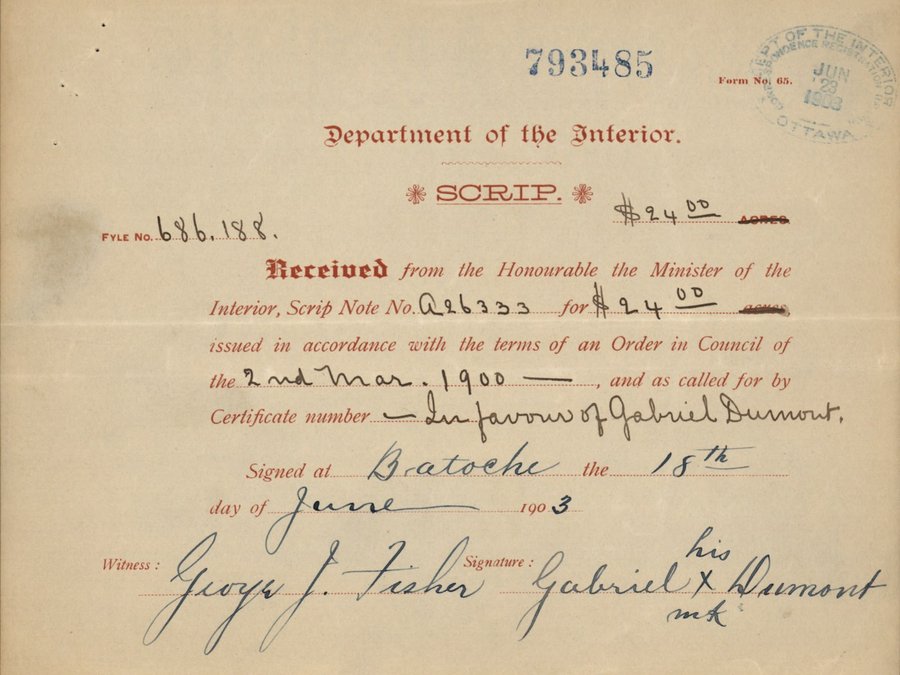
The second is the record that shows the ancestor at the top was Métis. Scrip is the one most often named. Library and Archives Canada describes Métis scrip documents as a key source for genealogical information, with birth dates not available in church records, and says the applications and affidavits usually include when and where the person was born, the names of their parents, and often details about siblings and children (LAC, Métis Nation genealogy, page modified 7 April 2026; LAC, Finding Métis scrip, page modified 23 March 2026). A scrip application can therefore do two jobs at once: it identifies the ancestor as Métis and it names the generation above them.
Census returns, fur trade records and parish registers fill the gaps. The Saskatchewan guide names scrip, census records, fur trade records and First World War attestation papers as its main primary historical documents. Ontario’s list of valid supporting documents includes long-form birth certificates, baptism certificates, marriage certificates, census records, published obituaries or death certificates, Indian Affairs records pertaining to Métis, fur trade records such as Hudson’s Bay Company journals, and Métis land scrip (MNO Registry FAQ, question 17).
One point that surprises people: the word Métis does not have to appear. The Ontario policy says there is no requirement that a document use the term, and that records using chicot, bois-brûlé, half-breed, French breed or other breed may, taken with other evidence, be acceptable (MNO Registry Policy, Guideline 8). The Saskatchewan guide lists Half-Breed, French Breed and Cri-Breed among the terms found in historical records. Reading a record correctly means knowing what those words meant when they were written.
What is not accepted as proof?
A family tree without documents behind it. The Métis Nation-Saskatchewan Registry says plainly that it will not accept family genealogy files or family trees downloaded from the internet, photocopies from published books, guides or indexes, or a family tree without supporting documents, because these are secondary sources that may help research but cannot prove a genealogical connection on their own (MN-S Genealogy Records Guide). Ontario’s FAQ says the same thing from the other side: a genealogical chart with no supporting documentation is insufficient.
That rule is the same one every documented family history runs on. A name copied from someone else’s tree is a hypothesis. A baptism, a scrip affidavit, a census line: those are evidence. Our earlier post on Métis ancestry research in Saskatchewan walks through what scrip and the parish registers each add.
My parent or grandparent is already a citizen. Do I still need the whole line?
Usually not the whole line, but you still need the documents that connect you to them. The Métis Nation of Ontario says that if your parent or grandparent is already a citizen with a complete file, you need only provide supporting documents that connect you to that person (MNO Registry FAQ, question 8). The Manitoba Métis Federation allows a relative’s genealogy to be used, provided you supply the birth or baptismal certificate of your parent showing the same mother and father as on the relative’s genealogy, and your own certificate naming your parents (MMF FAQs). The connecting documents are the same ones as before: a record naming parents, at each step between you and the person on file.
What should you gather before you spend anything?
Ask the registry what it already holds. Two of the five say they will do research on your behalf, and a third names the body that prepares the genealogy. Métis Nation British Columbia says its Indigenous Research team will find the publicly available documents once the family chart is in. The Métis Nation-Saskatchewan Registry says it holds more than 500,000 birth, baptismal, marriage, government and fur trade records, has agreements with eHealth Saskatchewan and Service Alberta to access vital events in those provinces, and that applicants do not normally need to conduct extensive genealogical research on their own. The Manitoba Métis Federation points you to the St. Boniface Historical Society for the genealogy itself.
What every registry needs from you is the chart, filled in as far as family knowledge goes, and the birth or baptismal records for the recent generations, which are the ones the archives do not hold. Where the line runs through a province whose vital records a registry cannot request, or through a name that changes spelling between a French parish register and an English scrip affidavit, that is where documenting a Métis line becomes archival work in its own right. Whether a particular line meets a particular registry’s standard is the registry’s decision to make, and it makes that decision on the documents in front of it.
Frequently asked questions
Is there a limit on how many generations back a Métis citizenship application can go?
No. The Métis Nation of Ontario states in its Registry FAQ that there is no generational cut-off for Métis citizenship, and none of the other four registries’ published requirements sets one. Each asks instead for a documented line, generation by generation, to an ancestor recorded as Métis in the historic homeland.
How far back does my Métis ancestor have to be?
It depends on the registry. Ontario requires a Métis ancestor who lived in the historic homeland after 1750. Saskatchewan requires an ancestor who lived in the homeland during the nineteenth century, 1800 to 1901, and was recognized as Métis in primary historical documents. Alberta asks for a family tree outlining Métis ancestry dating back to the mid-1800s. Manitoba requires a genealogy prepared by the St. Boniface Historical Society showing a connection to the Red River Métis.
What document proves each generation?
A birth registration or long-form birth certificate naming the parents, or a baptismal certificate naming them. Where a surname changed, a marriage certificate explains the change. The Métis Nation-Saskatchewan guide lists that pair of documents for every generation from the applicant upward.
What proves the ancestor was Métis?
A primary historical record that identifies them as Métis or by a term of the period. Scrip applications and affidavits are the most often cited, because Library and Archives Canada notes they record birth dates and parents’ names; census returns, fur trade records and church records are also named by the registries. Ontario’s policy states that the word Métis need not appear on the document.
Does a family tree from a genealogy website count?
No. The Métis Nation-Saskatchewan Registry will not accept family trees downloaded from the internet or a family tree without supporting documents, and the Métis Nation of Ontario says a genealogical chart with no supporting documentation is insufficient.
If my parent is already a citizen, do I need to document the whole line again?
The Métis Nation of Ontario says that if a parent or grandparent is already a citizen with a complete file, you need only provide the documents connecting you to that person. The Manitoba Métis Federation allows a relative’s genealogy to be used with the birth or baptismal certificates that tie you to it. Check with the registry you are applying to, since the rules are each government’s own.
If a Métis line in your family has stalled at a name nobody can place, the useful question is which record exists for that generation and where it is held. Book a consultation and we can look at what the line actually rests on.
Sources
– Métis Nation of Ontario, Frequently Asked Questions, MNO Citizenship Application, FAQ updated 4 November 2021, page modified 14 May 2026, read 27 September 2026.
– Métis Nation of Ontario, Registry Policy, AGA Approved 16 August 2025, read 27 September 2026.
– Métis Nation-Saskatchewan, Genealogy Records Guide for Application to the Métis Nation-Saskatchewan, read 27 September 2026.
– Otipemisiwak Métis Government, Guidelines and Requirements, page modified 11 September 2026, read 27 September 2026.
– Manitoba Métis Federation, Citizenship Application FAQs, read 27 September 2026.
– Métis Nation British Columbia, Your Journey to MNBC Citizenship, read 27 September 2026.
– Library and Archives Canada, Métis Nation genealogy, page modified 7 April 2026, and Finding Métis scrip, page modified 23 March 2026, both read 27 September 2026.