What is Family History Month, and why does October matter?
October is Family History Month, the month the genealogy community sets aside for finding, recording and preserving family history. The National Genealogical Society describes it as a time to explore, preserve and share the stories and memories of our families, and publishes free guides on scanning photographs and documents, recording interviews, and writing family stories. October matters for a practical reason as well. Documentary research is slow work, measured in weeks of ordering records and reading them, so a family history begun in the autumn has room to become something finished rather than something rushed.
My family has boxes of photographs and nobody left who remembers. Where does that go?
It goes into the research, and it is usually the best material anyone has. A photograph with a studio name printed on the mount tells you which town the family was in and roughly when. A funeral card gives a death date that finds a burial register. A christening gown wrapped in a newspaper dates itself. The work begins with what you already have, reviewed and catalogued, because those objects decide which archive gets written to first. The part nobody can replace is what the family still remembers, and that is the part that disappears quietly.
What does a documented family history actually contain?
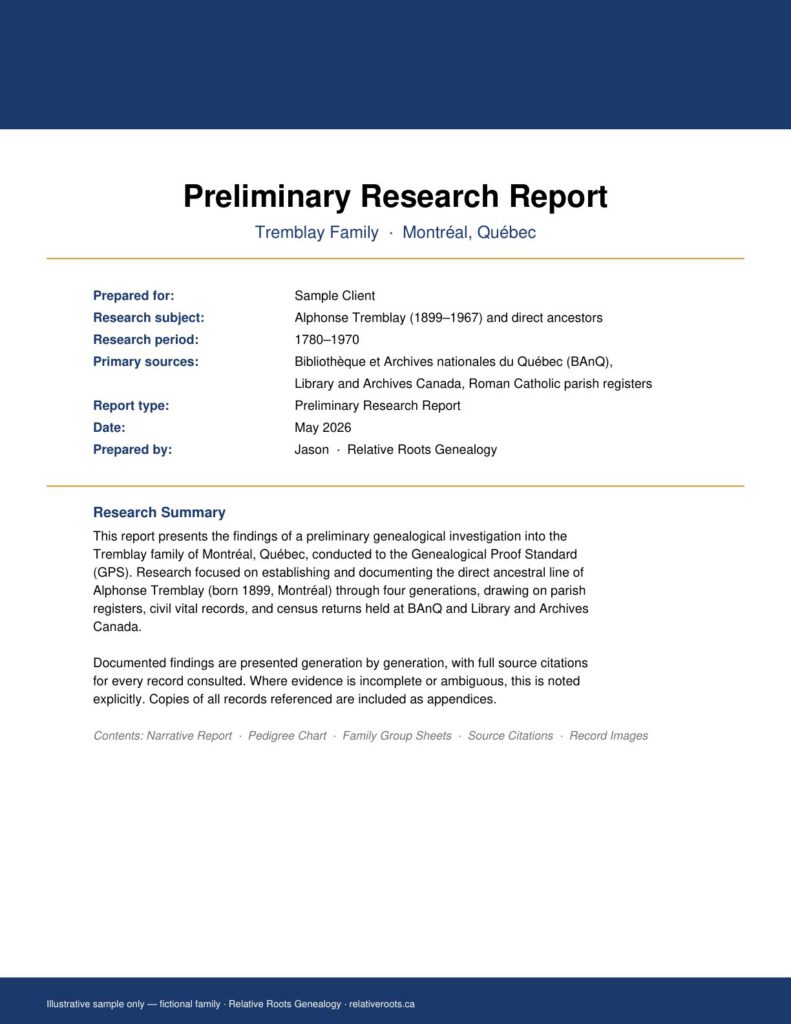
Five things, and none of them is a list of names. A written research report is the core of it: a narrative of what was found, what it means, and what questions remain, in plain language, with every conclusion supported by a cited source. With it come pedigree charts showing the direct line, usually four or five generations to a chart; family group sheets, one for each couple and their children, carrying vital dates, places and source references; and a GEDCOM file, the universal family tree format, which imports into any genealogy application and, because the format is open rather than owned by one company, does not depend on any single product staying in business. Alongside all of that, you receive a digital copy of every record located during the research. The census page itself. The ship manifest. The marriage register entry. Not a report about the documents, the documents.
Why does the citation matter if the name is right?
Because a name without a source cannot be checked, and an unchecked tree is where the same mistake gets copied for thirty years. Professional genealogy works to the Genealogical Proof Standard, published by the Board for Certification of Genealogists, and its requirements are plain: a reasonably exhaustive search, a complete and accurate citation for every item of information, analysis and correlation of the evidence, resolution of anything that conflicts, and a soundly reasoned written conclusion. A cited family history can be handed to anyone, including a sceptical relative or a researcher fifty years from now, and every statement in it can be traced back to the document it rests on. That is the whole difference between a family history and a family legend.
What happens in the first ten hours?
Every project begins with a ten-hour foundation retainer, and the shape of those hours is consistent. First comes the review of what you already hold. Then a research plan: which records to consult, which archives hold them, and what each one can realistically say. Then the research itself, which is iterative, because each record read changes what should be read next. Conflicts between sources are flagged and resolved against the standard rather than smoothed over. At the ten-hour mark you receive a preliminary report saying what has been found, what it means, and what the logical next steps are, and you decide whether to continue, pause or close the file. Where a goal genuinely needs less than ten hours, a smaller block is quoted instead. The details are on the family tree research page.
I already have a tree. Is this still worth doing?
Often it is worth more. A tree inherited from a relative, or assembled over years from online hints, usually contains good work and a few conclusions the evidence does not support, and from the inside there is no way to tell which is which. A research consultation and assessment is built for that case: an independent skeleton of the relevant lines is built first, from primary sources, without reading your version, precisely so that your assumptions cannot be inherited. Where the independent build matches yours, that is confirmation. Where it diverges, that is where the work starts. What you get back is a written assessment of what is solid, what is shakier than it looks, and a prioritised list of the next records and where they are held.
Is a researched family history a good gift?
It is one of the few gifts that gets better after it is given, because the report, the charts and the records can be copied and shared with everyone in the family and read again in twenty years. One caution, said plainly rather than buried: research runs on the archives’ schedule, not the calendar’s, and no honest genealogist can promise that a project started in the autumn will be finished by a particular date in December. If a fixed occasion matters, say so in the consultation and the scope is set around what can actually be done.
How do I start?
Gather what the family already holds and write down what the oldest people still remember, because that costs nothing and cannot be recovered later. If you would like to know what to do before hiring anyone, there is a whole post on starting genealogy research. When you are ready to have the records found and documented, the consultation is free and it is where the goals and the scope get decided. You can book a consultation directly.
Frequently asked questions
When is Family History Month?
October. The National Genealogical Society runs its Family History Month materials for the month of October and publishes free guides on scanning photographs and documents, recording family interviews, writing family stories, and joining a genealogical society or archive.
What is the difference between a family tree and a documented family history?
A family tree is a structure of names, dates and relationships. A documented family history is that structure with every claim in it attributed to a record, plus the written narrative that explains how the records connect and a copy of each record found. The first can be assembled from other people’s trees. The second cannot.
What is a GEDCOM file and why does it matter?
GEDCOM is the open standard file format for family tree data. A GEDCOM file of your research imports into Ancestry, Family Tree Maker, RootsMagic and other genealogy applications, or can be kept on its own as an archive. Because the format is open rather than owned by one company, the file stays readable whatever software your family uses later.
What if the research finds something the family will not like?
It is reported anyway, with the records that show it. The undertaking is honest documented answers, which sometimes means an answer nobody expected and occasionally means a line that does not hold up. Findings are not shaped to suit a story, and an honest negative result is recorded and explained rather than left out.
Do I need to have done research already?
No. A project can start from a single name and a town, or from thirty years of somebody else’s notes. What changes is where the first ten hours go, and that is settled in the free consultation before anything is booked.