Updated 14 August 2026: corrected which office holds a Quebec record, and clarified that IRCC asks for a colour copy from the original authority rather than a certified copy.
Families with Quebec ancestry often have a certificate already. It came out of a grandparent’s papers, it is old, and it looks entirely official. Whether it works as a Quebec birth certificate for citizenship by descent is a different question, and the answer has nothing to do with how long ago the birth or marriage happened.
In short: Quebec centralized civil registration on 1 January 1994. A Quebec birth or marriage certificate printed before that date is not accepted for a citizenship by descent application, no matter when the event itself took place. The replacement comes from whichever office now holds the record, and that depends on the record’s age rather than on 1994: the Directeur de l’état civil keeps the most recent hundred years, and Bibliothèque et Archives nationales du Québec holds everything older.
What to know before you order anything
- Quebec centralized civil registration on 1 January 1994 under the Directeur de l’état civil. Before that date, the parish register was the legal record.
- The print date on the certificate decides whether it is accepted, not the date of the event it records.
- Which office you order from depends on the record’s age, not on the 1994 date. The Directeur de l’état civil keeps the most recent hundred years and passes each year’s registers to BAnQ as they reach a century old.
- IRCC asks for a clear colour copy of a document issued by the original authority. Neither the application form nor the document checklist asks anywhere for a certified copy.
- Documents in French do not need translation. French is one of Canada’s two official languages.
Why does IRCC not accept my old Quebec birth certificate for citizenship by descent?
Because the rule turns on the issue date of the document, not the date of the event. IRCC states it plainly in its own help centre: “Do not send birth or marriage certificates issued in Quebec before January 1, 1994.” A certificate recording an 1890 birth is perfectly usable, provided the paper itself was printed after that line.
This catches people out because the instinct runs the other way. An older certificate feels closer to the source, and a document that has survived in the family for decades feels more authentic than something ordered last month. For this particular rule, the opposite is true. The older paper is the one that will be returned.
The date printed on the certificate matters more than the date recorded inside it.
What changed in Quebec on 1 January 1994?
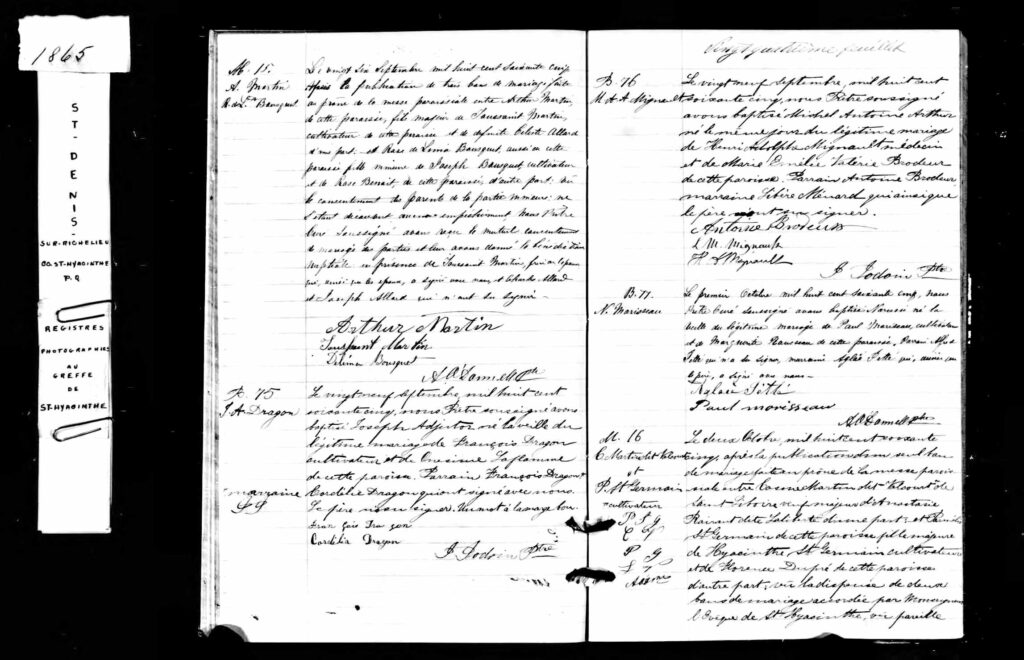
Before 1994, Quebec had no central civil register. Parishes recorded births, marriages and deaths in their own registers, and a duplicate copy went to the courts. Those registers were the legal vital record of the province, kept by the clergy rather than by a government registrar.
On 1 January 1994 the province centralized civil registration under the Directeur de l’état civil, which has issued Quebec certificates ever since. Everything before that date belongs to the older parish system. That is why IRCC draws the boundary exactly where it does: a certificate printed before 1994 came out of a system the province no longer operates.
The rule looks like pedantry until that history is in view. It is really a question about who issued the paper. Before 1994, the answer was a parish priest rather than the province.
What Quebec records does IRCC accept instead?
Two offices hold Quebec vital records between them, and which one you write to depends on how old the record is rather than on the 1994 date. The Directeur de l’état civil keeps the registers for the most recent hundred years. Each year it transfers the year that has just turned a century old to Bibliothèque et Archives nationales du Québec, which holds everything before that. As of 2026 the boundary sits at roughly 1926, and it moves forward every January.
So for an event in the 1930s or later, order from the Directeur de l’état civil. That office issues both a summary certificate and a fuller copy of an act. The copy of an act carries more detail, including the names of the parents, which is precisely what a descent claim has to establish.
For anything older, the record is the parish act itself, and Bibliothèque et Archives nationales du Québec holds the register.
Check whether the record is free before you pay for itBAnQ has been digitizing the parish registers and publishes them on BAnQ numérique. Its own ordering page says a copy can be downloaded there at no cost, or photographed in a BAnQ reading room. That download comes from the archive holding the original, which is the part that matters. Look there first.
If you do order, order everything at onceBAnQ charges for the first record in a request and much less for each additional record in the same request, up to nine records at a time. The same nine records ordered one by one cost several times what they cost together. Work out the full list before you submit anything.
Certification is optionalBAnQ will certify a copy, and the certification is included in the price it quotes for a civil status record. Neither the application form nor the document checklist asks for one. What IRCC asks for is a clear colour copy of a document issued by the original authority, and for an online application, a high resolution colour scan. Certification is available if you want it. It is not what makes the document count.
Do baptismal records count for a Quebec citizenship claim?
Sometimes, as supporting evidence rather than as the document that carries the claim. Published IRCC guidance allows well-sourced alternative records to be weighed on a balance of probabilities where an official record genuinely cannot be produced, and a baptism recorded within a reasonable time of the birth is among the strongest of those alternatives. Whether any particular record satisfies an adjudicator is IRCC’s call, not a genealogist’s.
The working rule is short. Order the certified document wherever one can be ordered. Reach for an alternative only where nothing better exists, and document why nothing better exists.
One thing that is not a problem is language. Quebec acts and certificates are in French, and French is one of Canada’s two official languages, so they are accepted as they are, with no translation required.
Which two documents carry a citizenship by descent file?
The birth record and the marriage certificate do most of the evidentiary work. The birth record does two jobs at once: it establishes the parent to child link, and for the Canadian-born ancestor it establishes the citizenship the whole claim rests on. The marriage certificate does the quieter job, bridging a legal name change across generations, most often a woman’s surname, while naming both sets of parents and pinning one generation to the next.
Everything else in a file supports those two. It is the same evidentiary logic behind what IRCC now accepts as proof of citizenship by descent: a document from the authority that created it, for every generation in the chain, with the gaps explained rather than glossed over.
Common questions
What Quebec birth or marriage records does IRCC accept for citizenship by descent?
Certificates and copies of acts issued by the Directeur de l’état civil on or after 1 January 1994, and reproductions of parish acts from Bibliothèque et Archives nationales du Québec for records more than a hundred years old. Anything printed in Quebec before 1 January 1994 should not be sent.
My Quebec birth certificate was issued in 1975. Can I still use it?
No. The rule follows the printing date, so a certificate issued in 1975 is not accepted even though the birth it records is older still. Order a fresh copy of the act from the Directeur de l’état civil, which will be issued under the current system.
Does a Quebec record written in French need to be translated?
No. French is one of Canada’s two official languages, so a Quebec certificate or parish act in French is accepted exactly as issued.
Where to start
Sort the chain before spending anything on it. Write out each Quebec event in the line with its date and its parish, then mark which side of 1994 the document you need will be printed on. Once that list exists the ordering becomes mechanical. This event comes from the Directeur de l’état civil. That 1840s parish act comes from BAnQ. Nothing gets ordered twice.
If your Canadian line runs through Quebec, the research and the paperwork are the same problem approached from two ends. You may want to read more about the Canadian citizenship by descent research service, or bring what you already have, a name, a parish, a rough date, to a free consultation and we can look honestly at what proving the claim would take.