My Canadian ancestor has no birth certificate. Does that end the claim?
No. It changes which record you order. A birth certificate is a government document made from a civil registration, and every province started registering births on a different date. Ontario began in 1869. Nova Scotia registered from 1864 to 1877, stopped, and resumed in October 1908. An ancestor born before the province was keeping records has no registration to certify, so the certificate you have been trying to order was never made. The record that does exist is usually a baptism, a delayed registration or a certified copy of an archived register, and it has to come from the office or archive that holds it.
Why is there no birth certificate to order?
Because the province was not registering births yet. Library and Archives Canada puts it plainly: before the mid-1800s, religious institutions and municipal, township or county offices were the main sources of birth, marriage and death information, and provincial governments began civil registration in the late 1800s and early 1900s. Each province keeps records for different periods and sets its own rules for access. Library and Archives Canada does not hold most vital records itself; they belong to the provinces, the territories and the churches.
Ontario is the clearest example. The Archives of Ontario states that the Government of Ontario has registered births, marriages and deaths since 1869. For events before that, the Archives holds some records kept by religious congregations, townships and courts, and it says they are few in number and do not cover the whole province.
Nova Scotia shows the other kind of gap. Civil registration of births began in 1864, continued to 1877 and then lapsed until 1908. The Nova Scotia Archives notes that even the 1864 to 1877 registrations are incomplete. A child born in Halifax in 1890 has no birth registration at all, not because it was lost but because nobody was making them.
What does IRCC actually ask for?
Proof of parentage and proof of Canadian status, for every generation. The document checklist for a citizenship certificate, CIT 0014 (08-2026), says an application must be supported by authentic, reliable and verifiable documents for every generation, and that it cannot be supported solely by third-party records. For each Canadian parent, grandparent or earlier ancestor, the checklist asks for one or more documents issued by the original authority, and its list begins with the parent’s provincial or territorial birth certificate.
The list does not end there. It also names a Canadian citizenship or naturalization certificate, a Certificate of Registration of Birth Abroad, a British naturalization certificate issued in Canada or Newfoundland and Labrador, and any other evidence that the parent is a Canadian citizen. The checklist adds that, under the Citizenship Act and the Citizenship Regulations, No. 2, IRCC may ask for further information or documents when processing an application.
Read those two paragraphs together and the position is clear. The birth certificate is the first item on the list, not the only one. When it does not exist, the file has to show what does exist, obtained from the authority that holds it, and it has to show why the certificate could not be produced. Whether a particular substitute is enough in a particular file is IRCC’s decision, and nobody outside IRCC can promise otherwise.
What record exists instead?
It depends on the province and the decade. Most gaps are filled by a baptism, a delayed registration or a certified copy of an archived registration.
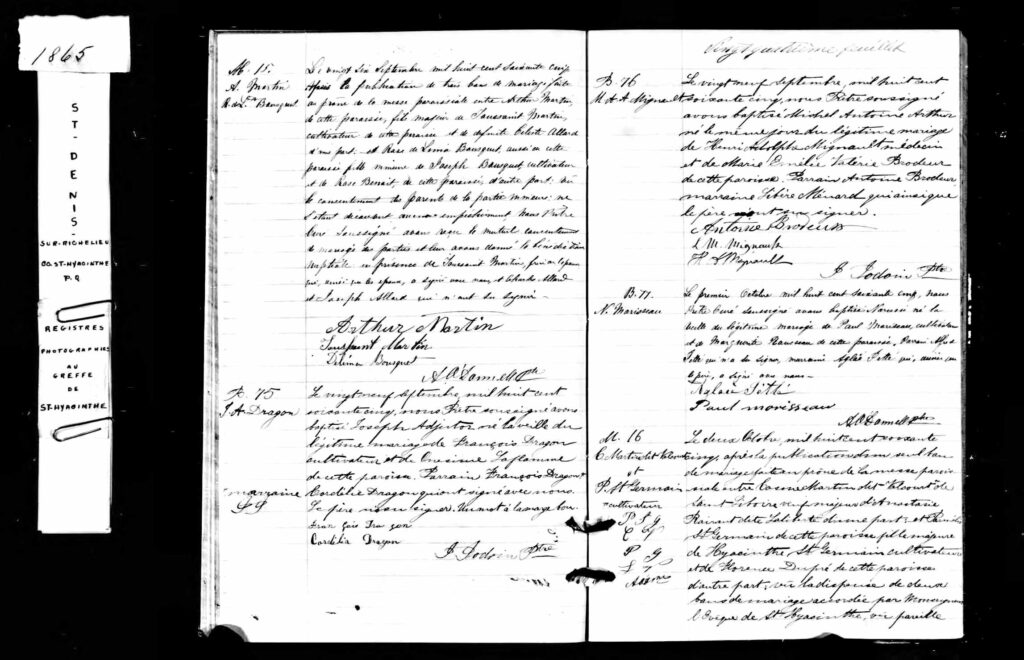
Start with the baptism. Before civil registration, the parish register was the record of a birth, and a Catholic or Anglican baptismal entry usually names the child, the parents, the date of baptism and often the date of birth. The register is held by the parish, the diocese or the provincial archive that took custody of it. A copy ordered from the archive or the church that holds the register is a record from the original authority. A transcription on a genealogy website is not.
A delayed registration is the next place to look. Nova Scotia is the best documented case. When registration resumed in 1908, people born earlier who needed proof of birth for a passport or a pension could register late, and the Nova Scotia Archives holds more than 100,000 of these files for people born between 1830 and 1909. Many carry the evidence the applicant supplied at the time: family Bible extracts, census abstracts and copies of church register entries, as many as four items in one file. The Archives has digitized the files and makes the images available free, with certified paper copies available to order.
A certified copy of an archived registration covers the remaining case. Where the province did register the birth but the record has passed to the archive, the archive issues the certified copy. The Archives of Ontario holds the original registration books for births to 1920 and states that a copy certified by the Archivist of Ontario can be used in place of the original certificate for legal, government or humanitarian purposes. Ontario births after 1920 are with the Registrar General through ServiceOntario. New Brunswick’s provincial archives holds a free, searchable database of provincial births, marriages and deaths, more than 1.1 million entries between 1800 and 1975, with the years covered differing by record type.
Which office do I order from?
The office that holds the register today, which is not always the office that made it. Ontario births to 1920 are ordered from the Archives of Ontario using the registration number found in the annual index. Nova Scotia births to 1924, including delayed registrations, are ordered from the Nova Scotia Archives, and births from 1925 onward from Vital Statistics at Service Nova Scotia. New Brunswick’s archive holds the older registrations and Service New Brunswick holds the later ones.
Quebec has its own rule. IRCC’s help centre says not to send birth or marriage certificates issued in Quebec before 1 January 1994, and for an older Quebec baptism the copy comes from the Directeur de l’état civil or from Bibliothèque et Archives nationales du Québec, depending on the year. The post on the Quebec 1994 rule sets out which office holds which years.
For a parish register that never passed to a provincial archive, the order goes to the diocese or the parish. Write down who was asked, when, and what they answered. That correspondence becomes part of the file.
What if there is no record at all?
Then the file has to prove the search. A birth that was never registered and a baptism that was never recorded, or whose register did not survive, leave a gap that cannot be filled with a certificate from anyone. What can be shown is that the right offices were asked and what they said, together with the nearest surviving records from an original authority: a marriage registration naming the parents, a census return placing the child in the household, a delayed registration made decades later, a burial entry.
This is the same standard genealogists apply under the Genealogical Proof Standard, where a documented negative search is evidence of reasonably exhaustive research rather than an apology for it. The checklist’s own language about further information or documents is the opening for that evidence. A search nobody wrote down cannot be shown to an officer. The earlier post on what IRCC accepts as proof covers the original-authority rule and why a subscription-site printout does not meet it.
How to work out which case you are in
Take the generation that was born in Canada and write down the province and the year. Then answer one question: was the province registering births in that year? If it was, the record is a registration, and the only question is whether the archive or the vital statistics office holds it now. If it was not, the record is a baptism or a delayed registration, and the search moves to the parish, the diocese and the provincial archive.
If that question is hard to answer for your family, or the register you need has moved and nobody can tell you where, the citizenship by descent research service exists for exactly this work: finding the record that does exist, from the authority that holds it, and documenting the search where it does not. The free consultation is where we work out which generation the gap sits in.
Frequently asked questions
Does IRCC accept a baptismal certificate instead of a birth certificate?
The checklist, CIT 0014 (08-2026), lists the provincial birth certificate first and then names other evidence, and it says IRCC may ask for further information or documents. A baptism copied from the parish or archive that holds the register is a record from the original authority. Whether it is enough for a particular generation is IRCC’s decision on that file, and no one else can make that promise.
When did Canadian provinces start registering births?
On different dates. The Archives of Ontario states that Ontario has registered births since 1869. The Nova Scotia Archives states that Nova Scotia registered from 1864 to 1877, lapsed, and resumed in October 1908. Library and Archives Canada says provincial and territorial governments began civil registration in the late 1800s and early 1900s, and that before then churches and local offices were the main record keepers. Check the province and the year before ordering anything.
What is a delayed birth registration?
A registration made years after the birth, usually when the person needed proof of birth for a passport or a pension. Nova Scotia holds more than 100,000 of them for people born between 1830 and 1909, and many include the evidence supplied at the time, such as family Bible extracts, census abstracts and copies of church register entries.
Can I use the baptism I found on a genealogy website?
Not on its own. The checklist says an application cannot be supported solely by third-party records and asks for documents issued by the original authority. The same entry, copied and certified by the archive or the church that holds the register, is what the checklist describes. The website copy tells you where to write.