# Your Quebec Ancestor’s Birth Predates the Civil Register. What the Directeur de l’état civil Can and Cannot Issue
You have been asked for a Quebec birth certificate for an ancestor. You ordered one, and nothing came back, or what came back was not what was wanted. Somewhere along the way you read that the Directeur de l’état civil can have a modern record created for an old Quebec birth. That idea is doing the rounds, and it is worth setting against what the office itself publishes.
In short: the Directeur de l’état civil issues a certificate or a copy of an act only for an event already entered in the Quebec register of civil status. Quebec has kept that register officially since 1994. The separate service called insertion exists for an act of civil status made outside Quebec, for a person domiciled in Quebec. An ancestor born in a Quebec parish in 1880 fits neither description, and the document that proves that birth is the register entry itself.
What to know before you order anything
– A civil status document can be issued only after the event is entered in the Quebec register of civil status.
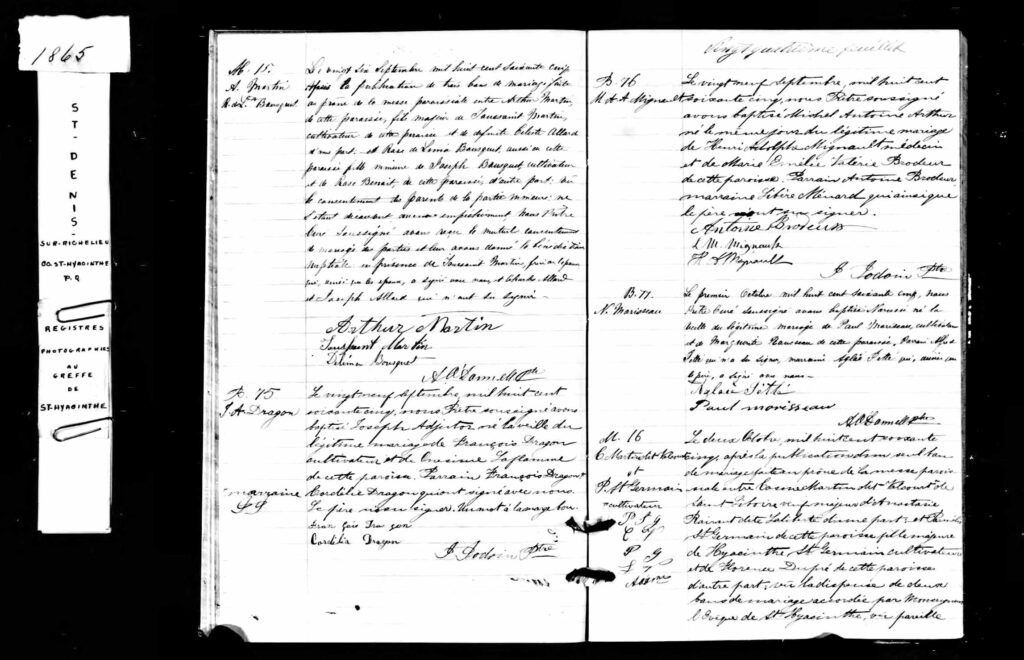
– From 1679 to 1993 the baptism was written in a parish register, and a copy of that register was deposited with the local court. That copy served as the civil register.
– Quebec has kept an official civil register, in which births are systematically entered, only since 1994.
– Insertion is for an act made outside Quebec, and the Directeur can do it only where the person concerned is domiciled in Quebec.
– Bibliothèque et Archives nationales du Québec makes the registers that are more than a hundred years old available. Anything more recent stays with the Directeur de l’état civil.
What does the Directeur de l’état civil actually hold?
It holds the Quebec register of civil status, and it issues documents from that register and from nowhere else. The office states the condition plainly: in order for a civil status document to be issued for a birth, marriage, civil union or death, the event must first be entered in the Quebec register of civil status (Entering an event in the register of civil status, reviewed 21 August 2025). The certificates and copies of acts page repeats it in the same words (Certificates and copies of acts, reviewed 31 July 2025).
That is the whole of the question. If the act is in the register, a document can be issued. If it is not, the office has nothing to issue from.
My ancestor was born in Quebec in the 1800s. Is that birth in the register?
Not in the modern register, no, and that is a matter of how Quebec recorded births rather than an oversight on anyone’s part. Bibliothèque et Archives nationales du Québec sets out the three periods in its genealogical guide to Quebec births: from 1621 to 1678 the baptism was entered only in a parish register; from 1679 to 1993 it was entered in a parish register and a copy of that register was deposited with the local court, the copy serving as the civil register; and since 1994 the Quebec government has officially kept a register of civil status in which births are systematically entered (Guide généalogique sur les naissances au Québec, read 20 September 2026).
So an 1880 baptism at Saint-Hyacinthe is not a gap in the register. It is a record of a different kind, held somewhere else, and it is the record that exists.
> The parish register is not a substitute for the civil record of an 1880 Quebec birth. It is the civil record of it.
Where is that record now?
It depends on the record’s age. BAnQ makes the registers that are more than a hundred years old available, and says on the same page that the diffusion and conservation of more recent acts and registers is the responsibility of the Directeur de l’état civil (BAnQ, read 20 September 2026). The line moves forward a year at a time, so the office to write to for a birth in 1940 is not the office to write to for a birth in 1880.
Our earlier post on the 1994 rule works through what IRCC accepts once you have the document in hand, and that is the piece to read next.
What is insertion, and does it apply to me?
Insertion has a narrow and published meaning. The Directeur de l’état civil describes it as insertion into the Quebec register of civil status of an act regarding a civil status event that took place outside Quebec, and states that it is the only public officer in Quebec authorized to do so, and that it can do so solely on the condition that the act concerns a person domiciled in Quebec (Insertion of an act made outside Québec into the Québec register of civil status, reviewed 13 December 2023).
Read those two conditions together and the shape of the service becomes clear. It is for a person living in Quebec who holds a birth, marriage, civil union or death record issued somewhere else, and who wants that record reflected in Quebec’s own register. An ancestor born in Quebec more than a century ago meets neither condition.
The same page sets out what insertion requires and what it produces. The application must carry the original document certifying the birth, issued by the officer of civil status of the country or province where the birth took place, along with the applicant’s photo identification, proof of home address, and proof of the person’s domicile in Quebec. The Directeur keeps the original for deposit in the register. There is no charge to examine an application and insert an act. An act made outside Quebec is semi-authentic under the Civil Code of Québec, it remains semi-authentic after insertion, and it becomes authentic only if a Quebec court recognizes its validity. Any document later issued bears an indication of that semi-authentic nature, and the office tells applicants it is their responsibility to check that the agency receiving it will accept a semi-authentic act.
Those are not the mechanics of creating a record for an ancestor. They are the mechanics of importing a record that already exists.
Then why do people say the Directeur creates a record for an old Quebec birth?
Because individual files produce individual answers, and an answer given on one file travels further than it should. Someone is told something on a telephone call, writes it down accurately, posts it, and it is read as general procedure by a hundred people whose situations are different. That is a working hypothesis about how the idea spread, offered as a hypothesis and not as a finding.
What can be said with confidence is narrower and more useful: the Directeur de l’état civil’s published pages describe insertion as a service for acts made outside Quebec, and describe certificates and copies as documents issued for events already in the register. If an officer has told you something else about your own file, that is a decision on your file, and the office’s written decision is the thing to keep. It is not published policy, and it should not be planned around before you have it in writing.
What should I do instead?
Work out which record actually exists for that birth, and which office holds it today, before you order anything. For most Quebec births before the early twentieth century the record is the parish register entry and its court copy, and BAnQ is where the search starts. For a birth inside the most recent hundred years, the Directeur de l’état civil holds it and can issue from it.
One practical note from the Directeur’s own page: before ordering, contact the organization asking for the document to find out which document it wants, because a certificate and a copy of an act are separate things. The same page adds that where a large number of certificates or copies are requested, or where applications are repeated, the Directeur may ask for additional information or documents to justify them (Certificates and copies of acts, reviewed 31 July 2025). A file built one ancestor at a time, with a reason for each request, runs into that less often than a scattergun order.
Frequently asked questions
Can the Directeur de l’état civil create a birth certificate for my ancestor born in Quebec in 1880?
The office issues a certificate or a copy of an act only for an event entered in the Quebec register of civil status, and Quebec has kept that register officially since 1994. For an 1880 birth the record is the parish register and the copy deposited with the local court, which BAnQ holds once it is more than a hundred years old.
Does insertion apply to a Quebec birth?
The Directeur de l’état civil describes insertion as applying to an act regarding a civil status event that took place outside Quebec, and only where the act concerns a person domiciled in Quebec. A birth that took place in Quebec does not meet the first condition.
What did Quebec use as a civil register before 1994?
From 1679 to 1993 the baptism was entered in a parish register and a copy of that register was deposited with the local court. BAnQ states that this copy served as the register of civil status.
Who holds a Quebec birth record from 1940?
The Directeur de l’état civil. BAnQ makes available the registers that are more than a hundred years old and states that more recent acts and registers remain the Directeur’s responsibility.
Is there a fee for insertion?
The Directeur de l’état civil states that there is no charge to examine an application and insert an act of civil status made outside Quebec into the register of civil status.
Will a document issued after insertion be accepted?
The office says an act made outside Quebec remains semi-authentic after insertion, that any document issued will carry an indication of that, and that it is the applicant’s responsibility to confirm the receiving agency accepts a semi-authentic act.
If your Quebec line has stalled on a document nobody can produce, the question is usually which record exists rather than which form to send. Book a consultation and we can look at what the generation actually left behind.
Sources
– Directeur de l’état civil, Entering an event in the register of civil status, reviewed 21 August 2025, read 20 September 2026.
– Directeur de l’état civil, Certificates and copies of acts, reviewed 31 July 2025, read 20 September 2026.
– Directeur de l’état civil, Insertion of an act made outside Québec into the Québec register of civil status, reviewed 13 December 2023, read 20 September 2026.
– Bibliothèque et Archives nationales du Québec, Guide généalogique sur les naissances au Québec, read 20 September 2026.